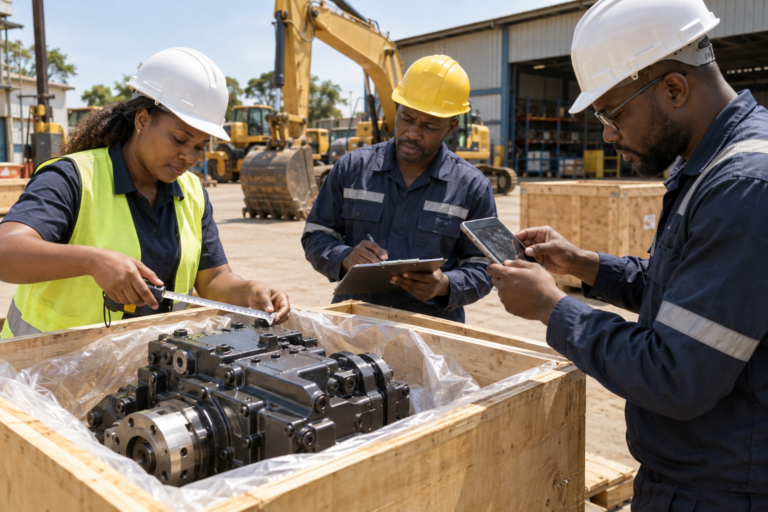

Direct answer: A useful machinery parts RFQ spreadsheet gives each requested item its own row and keeps machine identity separate from part identity. Record the complete model and serial number, marked number, requested quantity, installation position, photo references and delivery destination. Unknown information should stay visibly unknown rather than being replaced with an assumption.
Key takeaways
- Use one row for one requested item and one machine application.
- Separate marked numbers, catalog numbers and supplier references.
- Link every photo to the correct RFQ row.
- State destination and required timing without treating either as a delivery promise.
Start with machine identity
Record brand, complete model suffix, serial number and installed engine or major assembly when relevant. A fleet nickname such as ‘PC200’ is not enough when several generations or configurations operate on the same site.
Give each part a traceable identity
Use separate columns for the number physically marked on the old component, the requested orderable number and any superseded number supported by a catalog. Add the component location and the assembly in which it is installed.
Attach evidence without mixing rows
Name photographs with the RFQ row number. Include the machine plate, full component, connections, mounting position and readable markings. Put dimensions in dedicated columns with units.
Add commercial requirements last
After identity fields, record quantity, destination, preferred transport mode and required delivery window. Ask the supplier to state availability, lead time, packing and freight separately.
Run a completeness check
Before sending, filter for blank serial numbers, missing photo references, unclear units and duplicated line items. Mark urgent lines, but do not let urgency remove fitment checks.
Practical workflow
- Freeze the verified machine, assembly and part facts first. Leave unknown fields marked as unknown instead of filling them from visual similarity.
- Attach photographs, markings, measurements and records to the correct line item so another reviewer can follow the evidence.
- Ask the supplier to repeat the proposed identity, supplied scope and assumptions in writing before freight is compared or booked.
- After packing, reconcile quantity, package references, dimensions, weights, destination and document scope before dispatch.
Frequently asked questions
Can several machines share one RFQ?
Yes, but each line must name the exact machine and serial number. Do not use one machine header for parts that may belong to different units.
Should a casting number go in the part-number column?
Keep it in a separate marked-number field until a catalog or other reliable evidence connects it to an orderable service part.
What file format works best?
A spreadsheet is practical for multiple items. Keep original photographs in a clearly named folder or provide stable links that match the row references.
Related guides
- Part-number identification
- Verify fitment before ordering
- Prepare and compare a parts quote
- Request a parts quotation
Send a traceable parts inquiry
Include the machine model and serial number, marked part details, photographs, quantity and destination. An inquiry does not by itself confirm fitment, stock, price or delivery time.
Prepared as a procurement and identification guide. Machine-specific fitment, service procedures, customs requirements and transport commitments require separate verification.
About this guide
Published by Danch Machinery as general parts-identification and service-planning information. It is not a signed technical inspection or a machine-specific repair approval. Refer to the sources and scope stated in the article; confirm service procedures and fitment with the current manufacturer documentation for the exact machine.
Machine configurations and service requirements can differ by model, serial number and market. Confirm procedures and fitment with the current manufacturer documentation for your exact machine.