Direct answer: When no reliable seal-kit number is visible, identify the cylinder or hydraulic assembly first. Record the machine serial number, cylinder position, assembly marking, rod and bore information, gland and piston details, groove measurements and seal profiles. Measurements support identification, but a matching diameter alone does not prove material or pressure suitability.
Key takeaways
- Identify the cylinder position and assembly before measuring loose seals.
- Keep rod, piston, wiper and static seals separated.
- Record groove dimensions and seal profiles with units.
- Do not select material or pressure rating from appearance alone.
Start with the complete assembly
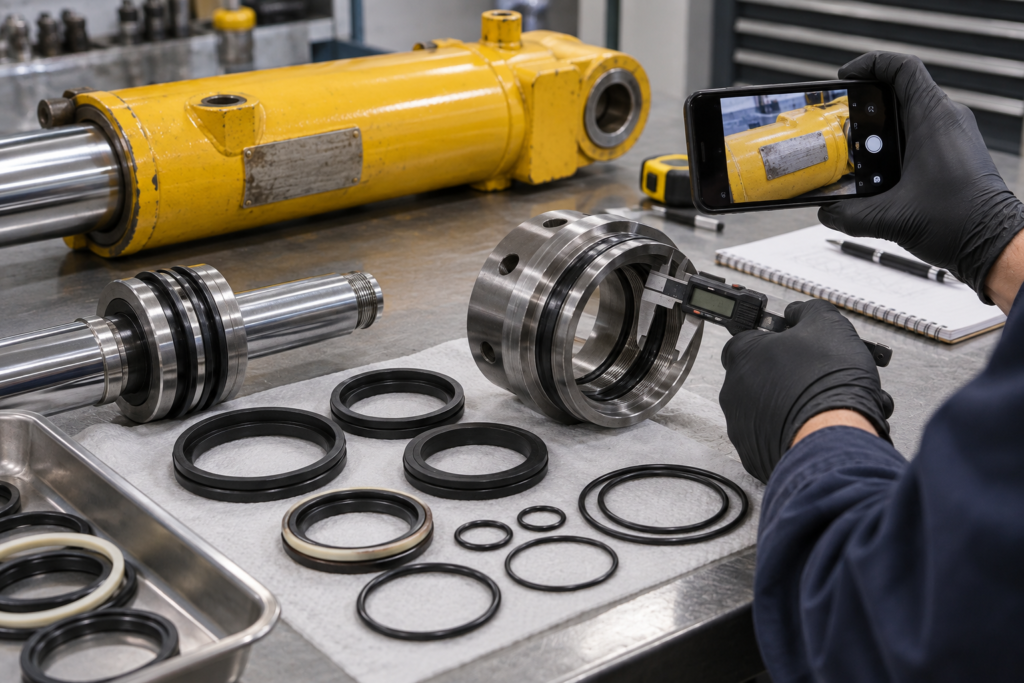
Photograph the installed cylinder, mounting ends, hose-port positions and any plate or stamped number. Similar cylinders can use different sealing arrangements.
Keep removed seals organized
Lay seals out in removal order and label their positions. Do not mix fragments from different grooves or cylinders.
Measure the hardware
Record rod diameter, bore or piston diameter, gland dimensions and accessible groove dimensions with a suitable measuring tool. Note wear or corrosion that may distort readings.
Describe the operating context
State the machine, cylinder function, observed leakage location, working environment and fluid information available from the applicable service record.
Confirm before installation
Ask the supplier to state the kit identity and included pieces. Material selection and repair procedure should follow the applicable manual and qualified service guidance.
Practical workflow
- Freeze the verified machine, assembly and part facts first. Leave unknown fields marked as unknown instead of filling them from visual similarity.
- Attach photographs, markings, measurements and records to the correct line item so another reviewer can follow the evidence.
- Ask the supplier to repeat the proposed identity, supplied scope and assumptions in writing before freight is compared or booked.
- After packing, reconcile quantity, package references, dimensions, weights, destination and document scope before dispatch.
Frequently asked questions
Can I order a kit from rod diameter only?
No. Several cylinders may share a rod diameter while using different grooves, profiles and materials.
Should damaged seals be measured?
They can provide clues, but deformation and wear reduce reliability. Hardware and assembly identification are stronger evidence.
Does a complete kit include every O-ring on the cylinder?
Not necessarily. Ask for an itemized kit scope and compare it with the applicable parts breakdown.
Related guides
- Part-number identification
- Verify fitment before ordering
- Prepare and compare a parts quote
- Request a parts quotation
Send a traceable parts inquiry
Include the machine model and serial number, marked part details, photographs, quantity and destination. An inquiry does not by itself confirm fitment, stock, price or delivery time.
Prepared as a procurement and identification guide. Machine-specific fitment, service procedures, customs requirements and transport commitments require separate verification.
About this guide
Published by Danch Machinery as general parts-identification and service-planning information. It is not a signed technical inspection or a machine-specific repair approval. Refer to the sources and scope stated in the article; confirm service procedures and fitment with the current manufacturer documentation for the exact machine.
Machine configurations and service requirements can differ by model, serial number and market. Confirm procedures and fitment with the current manufacturer documentation for your exact machine.